Front
Removing and installing front brake caliper
Preliminary work
1. Raise the vehicle.
2. Remove the wheel.
Removing front brake caliper (standard brake system and PCCB)
1. Open combination plug connection and pull out connector for brake pad wear indicator.
2. Remove brake caliper.
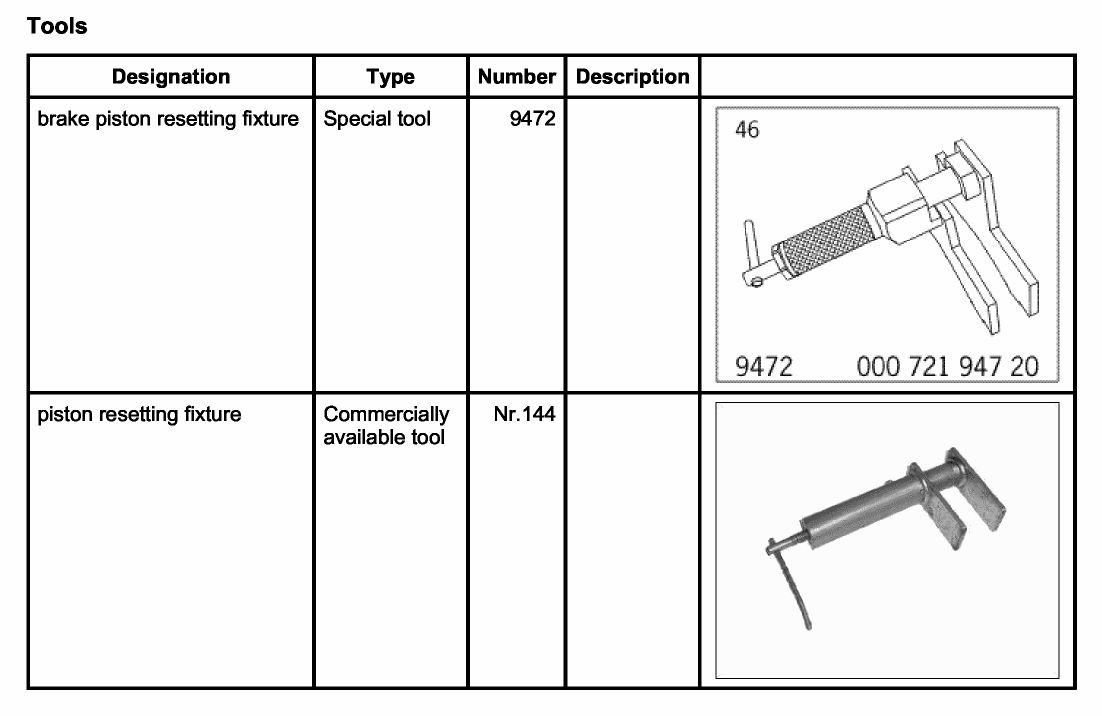
2.1. Use the piston resetting fixture Nr.144 or brake piston resetting fixture 9472 (PCCB brakes) to push the brake pads back slightly and uniformly -direction arrow-.
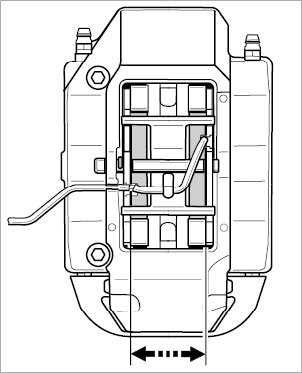
Pushing back brake pad
Removing/fitting brake line/brake caliper
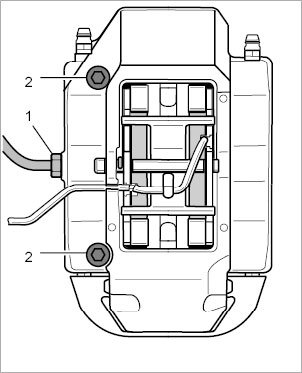
2.2. Loosen the brake line -1- on the brake caliper. Close off the brake line and brake caliper using suitable stoppers.
2.3. Loosen fastening screws -2- and remove the brake caliper (with brake pads fitted).
Installing front brake caliper (standard brake system and PCCB)
Removing/fitting brake line/brake caliper
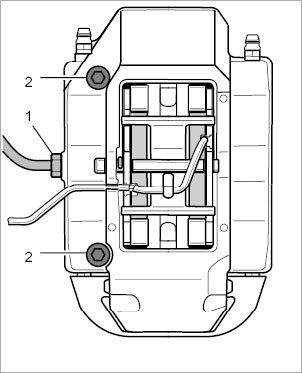
1. Fit brake caliper on the wheel carrier. Use new fastening screws -2-. Tightening torque: 85 Nm (63 ftlb.).
Fit the brake line -1- on the brake caliper.
Tightening torque for brake line -1- = 16 Nm (12 ftlb.).
2. Route brake pad wear indicator wire and connect the connector to the combination plug connection. Lock combination plug connection.
3. Bleed the brake system and adjust the brake fluid level.
Bedding in the brake pads - standard brake system
New brake pads require a bedding-in period of approx. 200 km. Only then do they achieve their maximum braking effect. The slightly reduced braking effect must be compensated for by increased pressure on the brake pedal. The same also applies after a brake disc change.
Bedding in the brake pads - PCCB
New brake pads require a slightly longer bedding-in period for PCCB brake discs than cast iron brake discs.
In general, the following applies: New brake pads must be worn in (bedding-in period), their optimum braking effect is not reached until after a few hundred kilometers. The slightly reduced braking effect must be compensated for by increased pressure on the brake pedal. The same also applies after changing brake discs.
Subsequent work
1. Fit wheel.