General Information
EVAP Control System Operation:
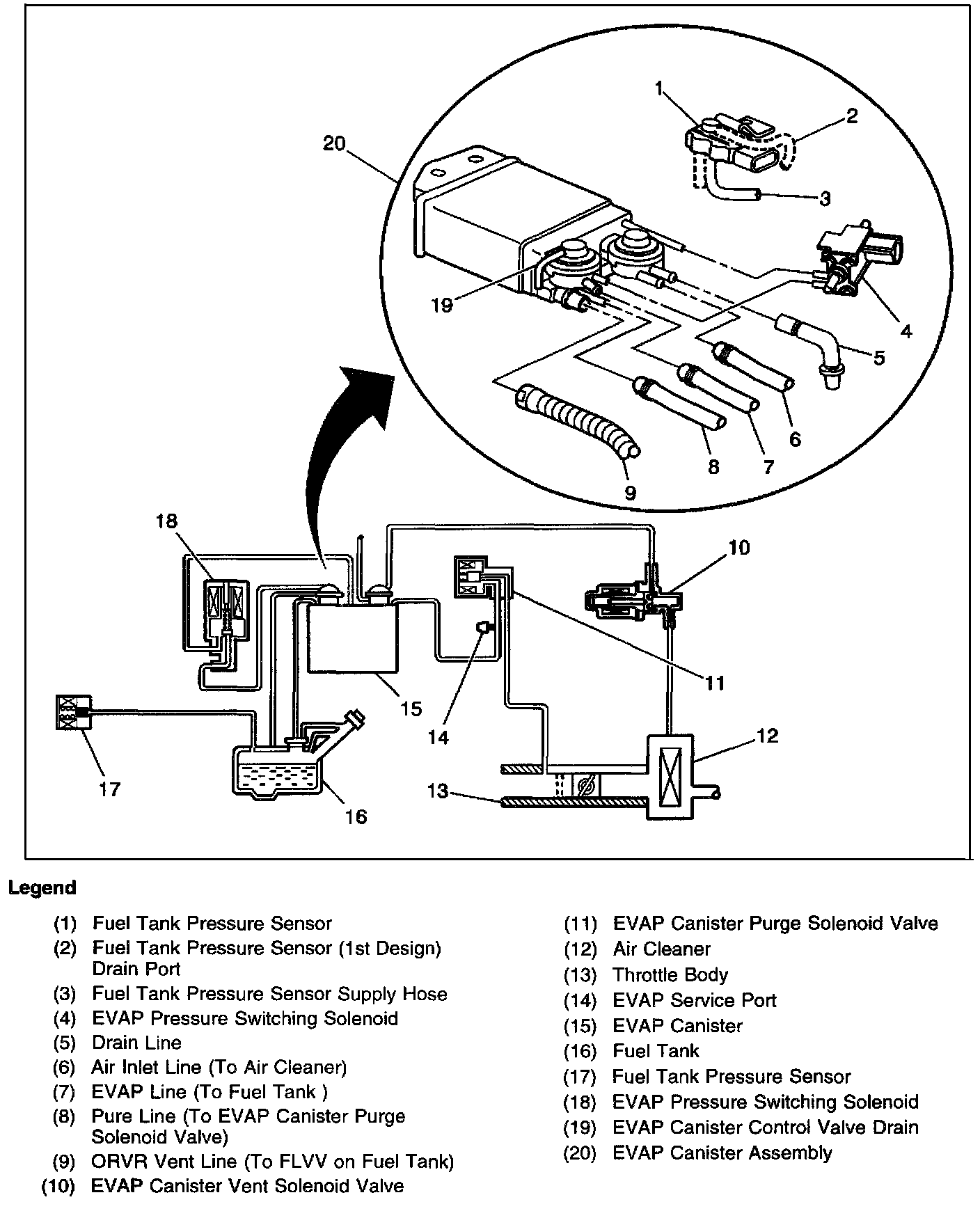
The EVAP system transfers the fuel vapor from the fuel tank to the EVAP canister. Once the engine is fully warmed up and operating above a specified speed, the stored fuel vapors are dispersed into the intake manifold. The fuel vapors are purged from the carbon element in the EVAP canister by the intake air flow and consumed in the normal combustion process.
The [1][2]EVAP control system is required to detect evaporative fuel system leaks as small as 0.040 inch between the fuel filler cap and the purge valve. The system integrity can be tested by applying a vacuum signal (ported or manifold) to the fuel tank. Sealing the other end of the EVAP system enables the applied vacuum to create a small pressure that can be monitored for leaks. The Powertrain Control Module (PCM) monitors the positive or negative pressure in the fuel tank. The PCM is able to detect any abnormal conditions by the fluctuation of this pressure. The PCM warns the driver of a malfunction in the EVAP system by illuminating the MIL.